
Modern Day Slavery in the United States: Exploring Forced Labor for Prison Inmates
Author: Kaitlyn Andres, MPH & MS
June 2, 2026
![An incarcerated worker operates a silkscreen machine, photographed as part of a Seattle Times investigation into prison labor in Washington. [Image credit: Alan Berner, The Seattle Times]](https://static.wixstatic.com/media/fe825d_90ca4a43108c40c888dca9cdcdf32056~mv2.jpg/v1/fill/w_728,h_484,al_c,q_80,enc_avif,quality_auto/fe825d_90ca4a43108c40c888dca9cdcdf32056~mv2.jpg)
The Thirteenth Amendment to the United States (U.S.) Constitution was passed in 1865 as a means to codify President Abraham Lincoln’s Emancipation Proclamation and abolish slavery. It stated that slavery would not exist in the U.S.; however, it also included an exception: punishment for a crime.
The Universal Declaration of Human Rights (UDHR) was adopted in 1948 and is generally considered the foundation of international human rights law. Article 4 also states that slavery should not exist and it does not list any exceptions.
U.S. law is at odds with the UDHR when it comes to slavery, despite the U.S. being one of the founding members.1
About 1.25 million people are incarcerated in either federal or state prisons in the U.S., with most (~1.10 million) in state prisons. 2 The most recently available data from the Survey of Prison Inmates reports that about 80% of those in federal prisons and about 60% of those in state prisons work, and about 75% of those say they are required to.3
Logistics of Employment
Inmates can receive work assignments within the facility in which they are incarcerated or outside the facility through state or federal prison industries.
Most incarcerated workers (~80%) work in jobs that maintain their facilities including janitorial duties, groundskeeping, food preparation, and laundry.3 For this type of labor, inmates at federal prisons can earn between $0.12 and $0.40 per hour.4 For those at state prisons, their potential wages vary by state, with some receiving no pay at all. The map below shows the upper limit of the pay range for inmates working within state prisons.5 Inmates in just four states have the possibility of earning over $1.00 per hour.
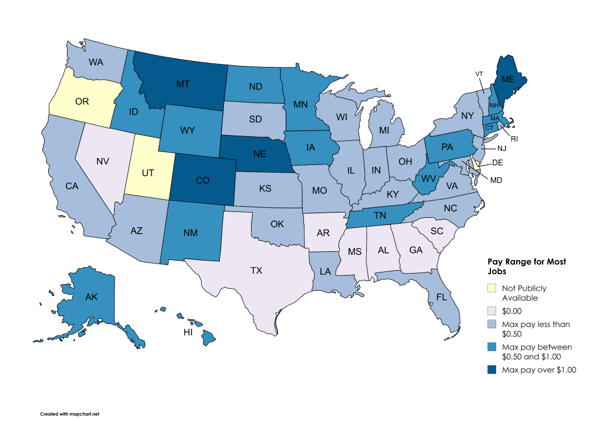
UNICOR, also known as Federal Prison Industries, is a program that employs inmates to produce goods and services that do not stay at their facility. Those working through this program can earn from $0.23 up to $1.15 per hour. UNICOR produces over 80 products or services that are sold mostly to agencies and departments of the federal government. The products and services include electronics, textiles, data entry, and vehicle repair. UNICOR’s largest “customer” is the Department of Defense, with over 50% of its sales going to that agency, and other customers include the Department of Homeland Security and the United States Postal Service.
Individual states also have prison industries that operate in a similar manner. Many states require their government and public institutions to purchase all of their furniture, printed materials, uniforms, and any other items possible from these “correctional industries.” Inmates working through state prison industries also often staff call centers, like those at the Department of Motor Vehicles. There is also an opportunity for inmates at state prisons to work in public works, maintaining state roads or public lands.5
A small number of inmates (less than 1%) are employed by private companies as contractors, producing goods or providing services for them. Workers in these positions typically receive higher hourly pay than mentioned above with some making minimum wage. However, as much as 80% of their pay can be deducted to cover expenses and financial obligations.5
There can be consequences for inmates who refuse job assignments. These include reduced commissary spending limits and placement in a lower housing status.6 Inmates rely on commissaries for essential personal items and may not be able to get what they need with lower spending limits. Housing status refers to the type of living arrangement assigned. The lowest housing status typically involves dorm-style living with double bunks. These repercussions can be quite serious and pressure inmates into doing work that they are not prepared to do or are uncomfortable performing. An incarcerated man in Arkansas reported that when he refused a work assignment picking cotton because of its symbolism with slavery, he was placed in solitary confinement.5
Beneficiaries of Prison Labor
Due to a lack of transparency and reporting requirements, it is difficult to quantify how much money prisons save by employing incarcerated individuals for their daily operations. A 2022 report from the American Civil Liberties Union and the University of Chicago Law School made a conservative estimate that in 2004, the savings to prisons totaled about $9 billion. This estimate is now over 20 years old.5
Federal and state government agencies save money by purchasing goods and services from the federal and state prison industries. Costs remain low because labor is inexpensive or unpaid. For example, there are incarcerated workers in Arkansas that make dorm furniture for no pay. Service costs are reduced because workers are not paid minimum wage and do not receive benefits. For example, the DMV in Oregon pays incarcerated workers about $4.00 to $6.00 per day for a job that they would have to pay $80.00 for if performed by a non-incarcerated worker. 5 The same report mentioned above estimated that in 2021, the value of the goods and services produced by inmates in just the state prison industries program was over $2 billion.
Private companies benefit similarly by exploiting low-cost or unpaid prison labor. Many companies in the U.S. benefit from prison labor, either by directly employing inmates or by purchasing products produced by inmate labor. An investigative report published in 2024 by the Associated Press found connections to prison labor in the supply chains of many major retailers, including Walmart, Target, McDonald’s, and Pizza Hut.7
Lack of Protections
There are legal protections in place for workers in the U.S. to protect their health, safety, and rights. These include the Fair Labor Standards Act (FLSA) and the Occupational Safety and Health Administration (OSHA). The FLSA defines federal minimum wage, which was last updated in 2009 to increase it to $7.25 per hour. OSHA is a federal agency that sets standards to keep employees safe and healthy on the job.
Unfortunately, these protections have not been extended to most inmates. While there is nothing in the text of the FLSA that explicitly excludes inmates, several court cases, including Bennett and Knipfer v. Frank, et al. in 2005, have ruled that inmates are not covered by the FLSA.8 Courts have reasoned that inmates are not imprisoned for the purpose of earning a living and that their labor offsets incarceration costs. In 1992, an inmate at Delta Correctional Center in Colorado wrote to OSHA regarding insufficient job training and workplace hazards. The OSHA Director of Compliance Programs responded with an interpretation letter explaining that state employees, including inmates employed by state prisons, are not protected by OSHA.9
Despite this lack of protection, inmates are still assigned to dangerous positions, with some operating heavy machinery or fighting forest fires. Incarcerated workers report that they do not receive proper training or adequate personal protective equipment.5 An investigation in California in 2018 found that inmate firefighters were more likely to be injured than professional firefighters.10 Those performing these tasks should be compensated appropriately commensurate with the risks involved.
Disparities in the Incarcerate Labor Force
One major concern with forced prison labor is the overrepresentation of certain demographic groups in the prison population. As shown in the table below, Black individuals, Hispanic individuals, and men make up a higher percentage of the federal prison population than the general U.S. population. Racial and ethnic disparities in the legal system, along with broader systemic inequalities such as poverty, contribute significantly to these outcomes.11,12

Conclusion
Different groups argue in favor of prison labor for various reasons. Some inmates acknowledge benefits, including skill development and reduced boredom.3 However, the central issue is that inmates are exploited when they are forced to work in positions where others benefit financially while they lack protections. They remain vulnerable due to the significant power imbalance between incarcerated workers and those who employ them.
In order to eliminate this modern day practice of slavery and grant dignity to incarcerated workers, we should advocate for:
Payment of minimum wage for all work performed
Elimination of punitive consequences to ensure work is voluntary
Extension of health and safety protections
Increased transparency and reporting requirements
Glossary
Codify - To take a legal decision or act and formally organize it within legal frameworks
Fair Labor Standards Act (FLSA) - The law governing minimum wage, overtime, and child labor protections in the U.S.
Occupational Safety and Health Administration (OSHA) - The agency within the United States Department of Labor responsible for workplace safety standards
Footnotes/References
History of the Declaration | United Nations. Accessed April 29, 2026. https://www.un.org/en/about-us/udhr/history-of-the-declaration
Mueller D, Kluckow R. Prisoners in 2023 – Statistical Tables. Bureau of Justice Statistics; 2025.
Beatty LG, Snell TL. Work Assignments Reported by Prisoners, 2016. U.S. Department of Justice; 2023.
Federal Bureau of Prisons. Work Programs. 2026. Accessed April 16, 2026. https://www.bop.gov/inmates/custody_and_care/work_programs.jsp
Code of Federal Regulations. Inmate Financial Responsibility Program.; 1991.
Clark RA. Occupational Safety and Health Administration Standard Interpretation 1975.5. December 16, 1992. Accessed April 16, 2026. https://www.osha.gov/laws-regs/standardinterpretations/1992-12-16-1
Vesoulis A. Inmates Fighting California Wildfires More Likely to Be Hurt. TIME. November 16, 2018.
U.S. Census Bureau. QuickFacts: United States. July 1, 2025. Accessed April 16, 2026. https://www.census.gov/quickfacts/fact/table/US/PST045225#PST045225
BOP: Population Statistics. Accessed April 29, 2026. https://www.bop.gov/about/statistics/population_statistics.jsp


