
The Human Cost of Dangerous Migration Routes
Author: Mathilde Guenin, MS
September 1, 2026
View the interactive report on Tableau
This research highlights the human rights consequences of unsafe migration pathways by examining the prominence of different migration routes taken over time, who is taking them, and their consequences.
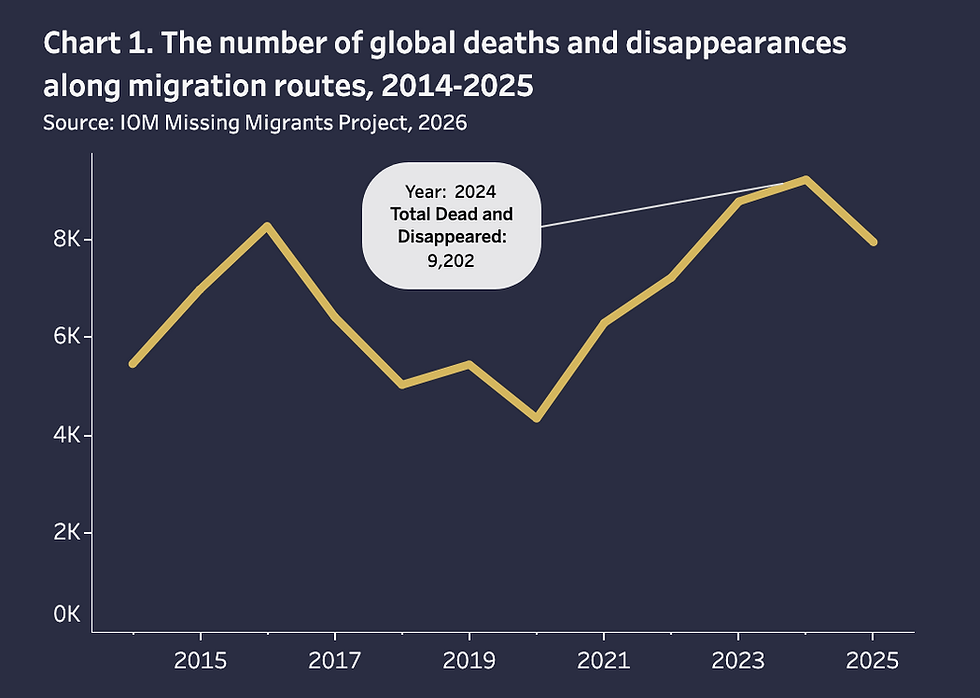
As illustrated in Chart 1, since 2014, deaths and disappearances along migration routes globally have reached two major peaks: around 8,300 people were recorded dead or missing in 2016, and approximately 9,200 in 2024.
Where do the people come from?
Chart 2 maps the countries of origin of people recorded as dead or missing along migration routes since 2014.
Afghanistan stands out, with the number rising from 327 in 2020 to 1,546 in 2025. This increase follows the Taliban takeover in 2020, which led many people to leave Afghanistan because of growing insecurity and worsening living conditions. The 2025 figure was about 4.7 times higher than in 2020, which represents an increase of approximately 373% in five years.
Ethiopia has seen a similar rise, from 116 recorded deaths and disappearances in 2021 to 789 in 2025. Years of conflict, drought, poverty, and cuts to humanitarian aid have continued to drive migration from the Horn of Africa (International Rescue Committee, 2026). Poverty has become particularly severe, with the rate reaching 43% in 2025. This has reversed years of progress in poverty reduction and pushed Ethiopians to leave the country. Insecurity in several regions, particularly in the Amhara region, where fighting between federal forces and the Fano militia has made the situation even worse, disrupts livelihoods and leaves many people with few options other than leaving the country (infomigrants, 2025).
Finally, Myanmar has recorded consistently high numbers since 2015, largely linked to the situation of Rohingya refugees facing persecution, violence, and discrimination. Consequently, many have attempted dangerous journeys across the Bay of Bengal and the Andaman Sea (International Organization for Migration (IOM), 2015).

Crises in countries of origin are pushing more people onto dangerous routes. At the same time, tighter border controls and more restrictive migration policies are making safe and regular pathways more difficult to access. For example, after Pakistan introduced visa requirements for Afghans in 2023, more Afghans reported intending to use unofficial crossings. As a result, many travelled to Iran using unofficial routes because they lacked travel documents (UNHCR, 2025). In Europe, border closures and restrictions on access to asylum, such as Finland’s closure of its eastern border with Russia following the invasion of Ukraine, have also made it more difficult for people to seek protection (UNHCR, 2024). Rather than stopping migration, stricter border controls can redirect people towards smugglers and more dangerous routes.
In Which Regions Do These Tragedies Occur?
The Mediterranean region was the deadliest global migration region every year between 2014 and 2025. The figure peaked in 2016, when almost 5,100 people were recorded dead or missing. This period coincided with what was described as the “migration crisis” in Europe. The “crisis” was marked by high arrivals to Europe linked to conflict, political instability, and insecurity in countries of origin. For example, many Syrians escaping the civil war, poverty, and insufficient humanitarian aid crossed the Eastern Mediterranean from Türkiye to Greece (The Guardian, 2015). Similarly, Eritreans fleeing political repression and forced military conscription travelled through North Africa and crossed the Central Mediterranean towards Italy (mixed migration, 2016).
Chart 3 is interactive.
Which routes are the most dangerous?
Some migration routes are especially dangerous, with high numbers of deaths and disappearances recorded.
Chart 5 confirms the patterns discussed previously. The Afghanistan–Iran route is particularly deadly for Afghans, while the high number of deaths in the Bay of Bengal and Andaman Sea is closely linked to the Rohingya refugee crisis. The Central Mediterranean route, used by many people trying to reach Europe, remains the deadliest.

Other dangerous routes include crossings through the Sahara Desert. People from East, West, and the Horn of Africa travel north towards countries such as Libya and Algeria, often intending to reach the Mediterranean coast. In Niger, a 2015 law criminalised the transport of migrants travelling irregularly towards Libya and Algeria. To avoid arrest, smugglers began using more remote desert routes, increasing the risk of abandonment, dehydration, starvation, and deaths (Mixed Migration Centre, 2023). The number of deaths is also likely to be underestimated because many people disappear in remote desert areas without being recorded.
Another dangerous route is the West African Atlantic route, which connects the coasts of West and North Africa to Spain’s Canary Islands. The long journey across the Atlantic, featuring unpredictable conditions and overcrowded boats, exposes people to drowning, boats drifting away, dehydration, and hunger (UN News, 2026).
The US–Mexico border is also one of the world’s deadliest land migration routes. Many deaths occur during crossings of the Sonoran and Chihuahuan deserts, where people face extreme temperatures, dehydration, and limited access to assistance (IOM, 2023).
Chart 6 compares arrivals at the Greek islands with people stopped or rescued by the Turkish Coast Guard on the same route. The number of people stopped or rescued before reaching the islands is higher than the number of arrivals, and both figures increased between 2022 and 2024. According to the Aegean Boat Report, arrivals to the Greek islands are fluctuating and decreasing because of stricter border controls, pushback practices, and the number of boats stopped or rescued by the Turkish Coast Guard before reaching Greece.

The human cost of migration is increasing for people fleeing conflict, persecution, and insecurity in countries such as Afghanistan, Myanmar, and Ethiopia. As safe and regular pathways become increasingly limited, people are pushed towards more dangerous routes, where border controls, interceptions, and gaps in rescue capacity increase the risk of death and disappearance. Many countries in the Global North have responded to increased migration by introducing more restrictive migration and asylum policies. However, these measures may redirect migration rather than reduce it, forcing people to use more irregular and dangerous routes. This is particularly concerning as conflict and climate-related pressures will continue to drive displacement and migration around the world.
Glossary
Amhara region: The Amhara National Regional State is located in northern Ethiopia and has a population of 22.5 million people, accounting for 22% of the total population of Ethiopia. Ethiopia’s Amhara region has been torn apart by a bloody conflict between federal forces and a coalition of militia known as Fano, who demand full Amhara control of all territory they regard as part of their homeland. For more information: https://www.thenewhumanitarian.org/news-feature/2024/11/12/who-fano-inside-ethiopia-amhara-rebellion
Border controls: Border control consists of actions taken by a country or a group of countries to monitor the borders and regulate the cross-border movements of people, goods and animals. Regarding migration, border controls enable the regulation of entry and exit of people, and thus the management of legal and irregular cross-border movements. Other terms used in the literature are border surveillance, border management, passport control, etc.
Fano militia: Fano is not a single militia but a loose network of Amhara nationalist fighters, organised locally by zone – Gojjam, Gondar, Wollo and North Shewa – alongside defectors from the Amhara regional forces. “Fano is very decentralised and fragmented,” says Horn of Africa analyst Abdifatah Hassan Mohamed. “They are united by a broad goal of protecting Amhara interests and opposing the Addis Ababa government.”
Interceptions: The action of stopping and catching something or someone before that thing or person is able to reach a particular place.
Niger’s Law 2015-36: A law that was introduced to fight migrant smuggling. It punished drivers and other people who transported migrants when the journey was considered irregular.
Pushback practices: Pushbacks entail a variety of state measures aimed at forcing refugees and migrants out of their territory while obstructing access to applicable legal and procedural frameworks. In doing so, States circumvent safeguards governing international protection (including minors), detention or custody, expulsion, and the use of force.
Rohingya: The Rohingya are a Muslim ethnic minority, mostly located in the Rakhine State of Myanmar. They have been targeted by the Myanmar government for decades. The Myanmar government labels the Rohingya as ‘illegal immigrants,’ claiming that they came from Bangladesh during British colonization and are not native to Myanmar.
Smuggler boats: Boats used for the clandestine, illegal transport of goods, currency, or people across international borders to evade customs, taxes, or law enforcement.
Taliban: The Taliban are the ultraconservative political and religious faction that emerged in Afghanistan in the mid-1990s following the withdrawal of Soviet troops, the collapse of Afghanistan’s communist regime, and the subsequent breakdown in civil order. It began as a small force of Afghan religious students and scholars seeking to confront crime and corruption; the faction owes its name, Taliban (Pashto: Ṭālebān, “Students”), to this initial membership. After the United States left Afghanistan in 2020, the Taliban regained power.
References
Aegean Boat Report. Aegean Boat Report. https://aegeanboatreport.com/
European Center for Constitutional and Human Rights. “Pushback.” https://www.ecchr.eu/en/glossary/push-back/
InfoMigrants. 2025. “‘The Only Solution Is to Leave’: Ethiopians Driven into Exile by Poverty and Insecurity.” https://www.infomigrants.net/en/post/68406/the-only-solution-is-to-leave-ethiopians-driven-into-exile-by-poverty-and-insecurity
InfoMigrants. 2026. “Why the Mediterranean Route Is Becoming More Deadly for Migrants.” https://www.infomigrants.net/en/post/71045/why-the-mediterranean-route-is-becoming-more-deadly-for-migrants
International Organization for Migration. Missing Migrants Project. https://missingmigrants.iom.int/
International Organization for Migration. 2015. “IOM Revised Appeal: Bay of Bengal and Andaman Sea Crisis.” August 2015. https://www.iom.int/sites/g/files/tmzbdl2616/files/country_appeal/file/IOM-Revised-Appeal-Bay-of-Bengal-and-Andaman-Sea-Aug2015.pdf
International Organization for Migration. 2023. “US–Mexico Border World’s Deadliest Migration Land Route.” https://www.iom.int/news/us-mexico-border-worlds-deadliest-migration-land-route
International Rescue Committee. 2026. “Ethiopia Crisis: Why Millions Need Support and How You Can Help.” https://www.rescue.org/uk/article/ethiopia-crisis-why-millions-need-support-and-how-you-can-help
Migration Research Hub. “Border Control.” https://migrationresearch.com/taxonomies/topics-migration-governance-migration-policy-and-law-border-control
Mixed Migration Centre. 2017. “The Eritrean Exodus: What Happened in 2016?” https://mixedmigration.org/articles/the-eritrean-exodus-what-happened-in-2016/
Mulia, Jalaluddin Rizqi, Triyasa Panji Bagaskoro, and Subulu Salam. 2025. “Perpetual Struggle for Freedom: Examining the Dynamics of Afghans Migration to Iran Post-Taliban Takeover.” Jisiera: The Journal of Islamic Studies and International Relations 8 (2): 77–117. https://doi.org/10.5281/zenodo.17388819
The Guardian. 2015. “Six Reasons Why Syrians Are Fleeing to Europe in Increasing Numbers.” https://www.theguardian.com/global-development-professionals-network/2015/oct/25/six-reasons-why-syrians-are-fleeing-to-europe-in-increasing-numbers
UN News. 2026. “Global Hunger Declines Again but Progress Remains Uneven across Regions.” https://news.un.org/en/story/2026/07/1167985
United Nations High Commissioner for Refugees. 2024. “Closing Borders to Those Seeking Asylum in Finland Sets a Dangerous Precedent, Warns UNHCR.” https://www.unhcr.org/europe/news/press-releases/closing-borders-those-seeking-asylum-finland-sets-dangerous-precedent-warns
United Nations High Commissioner for Refugees. 2025. “Afghanistan Border Monitoring Report: January–May 2025.” https://www.unhcr.org/sites/default/files/2025-07/afghanistan-border-monitoring-report-january-may-2025.pdf
United Nations High Commissioner for Refugees, International Organization for Migration, and Mixed Migration Centre. 2024. “On This Journey, No One Cares If You Live or Die: Abuse, Protection and Justice along Routes between East and West Africa and Africa’s Mediterranean Coast – Volume 2.” https://www.unhcr.org/media/journey-no-one-cares-if-you-live-or-die-abuse-protection-and-justice-along-routes-between-1


