
Humanitarian Organisations Condemn RSF’s War Crimes in el-Fasher, Call for International Intervention
Author: Erina Bazán López
October 31, 2025
HRRC strongly condemns the atrocities committed against civilians by the RSF in el-Fasher, Sudan. The mass killings of civilians and aid providers and attacks on civilian infrastructure constitute a breach of International Humanitarian Law and International Human Rights Principles. HRRC joins humanitarian organisations in calling for international intervention to end the ongoing atrocities in Sudan and deploy crucial humanitarian assistance.
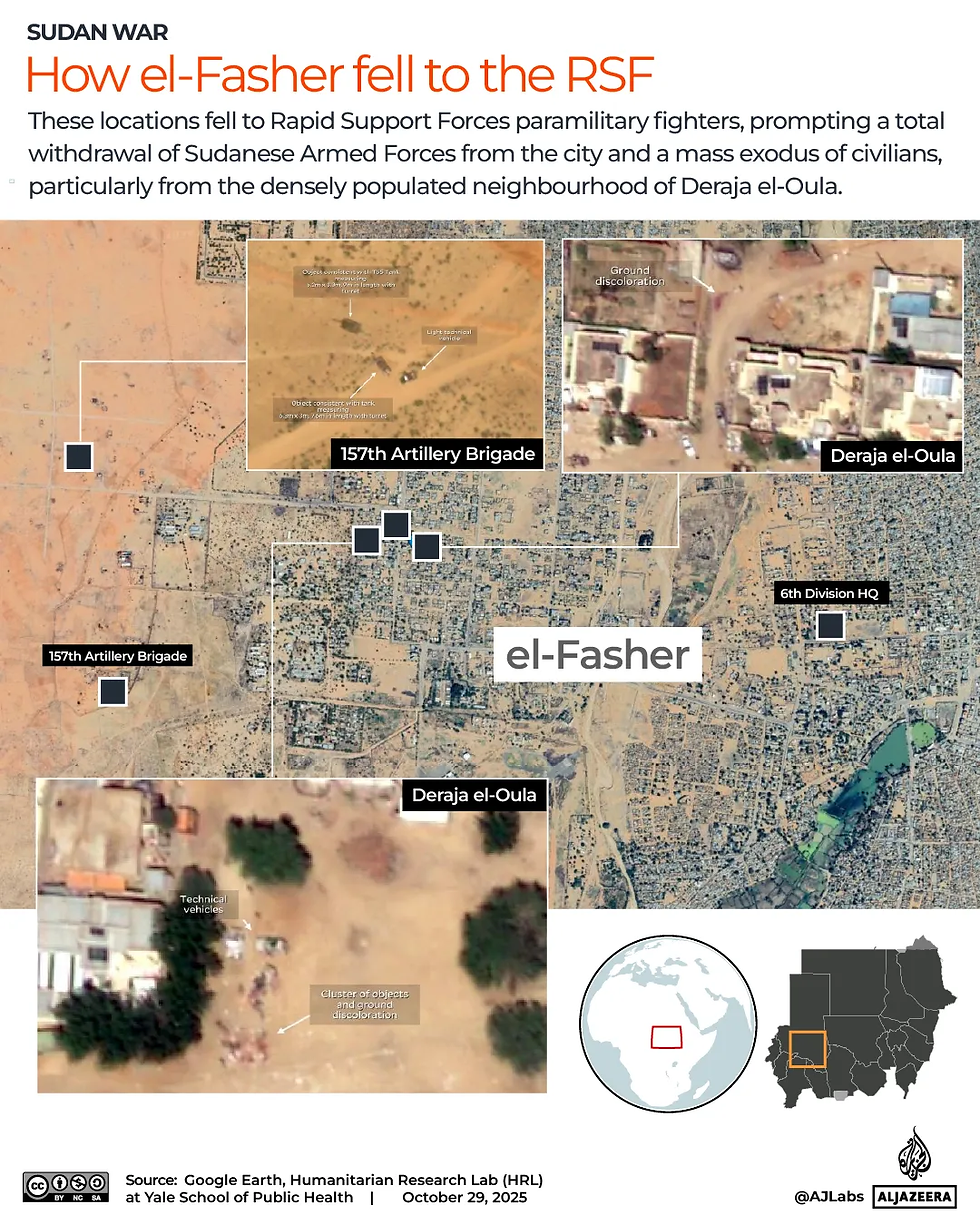
On Sunday, October 26th, the Rapid Support Forces (RSF) took over the city of el-Fasher in Sudan. El-Fasher had been under siege by the RSF since May 2024. The ongoing siege displaced over 26,000 of civilians, and left thousands more trapped within the city with no access to humanitarian aid amidst the fighting.
Just 48 hours after the takeover, Yale's Humanitarian Research Lab released an analysis of the city using satellite imagery, prompting outrage from humanitarian organisations. The analysis concluded that the images of reddish sand, and of newly appeared clusters of unmoving light objects on the ground–consistent with the dimensions of human bodies–supported reports of mass-killings of civilians fleeing after the RSF's assault on El-Fashir.
The images and analysis corroborate the reports of mass killings in the Former Children’s Hospital, the Saudi Maternity Hospital, the Red Crescent Society of Sudan (RCS) Office and the vicinity of the earthen wall outside the city. These hospitals and healthcare providers are unequivocally protected in the Geneva Conventions, their Additional Protocols and the Hague convention, and thus, the attacks on them, the wounded inside and the workers in there are war crimes.
Multiple humanitarian organisations, such as OCHA, The Inter-Agency Working Group, Plan International, the ICRC, and the WHO, have condemned these killings and atrocities, as well as other reported crimes from civilians attempting to flee, such as abductions, sexual violence, extortion, and even executions. Humanitarian organisations call for urgent action from the international community, asking governments to do what they can to cease the hostilities in Sudan, ensure an entry and access to aid, and demand the protection of the civilians and aid providers. Without urgent intervention, the atrocities being committed since the fall of el-Fasher could surpass the horrors of the Darfur Genocide. It is imperative that the international community act to prevent such tragedies from recurring.
Glossary
Abductions – When people are taken away illegally by force.
Atrocities – Extremely cruel or violent acts.
Civilians – People who are not members of the armed forces involved in a conflict.
Darfur Genocide – Refers to the mass killings, displacement, and persecution of people in Darfur, Sudan, beginning in 2003.
Displaced persons – People forced to leave their homes because of war, violence, or disaster.
El-Fasher – The capital city of North Darfur, Sudan; a strategic location in the ongoing conflict.
Extortion – Forcing someone to give money or services through threats or violence.
Geneva Conventions – International treaties that establish rules for the humanitarian treatment of people during conflicts.
Hague Convention – International agreements that regulate warfare and guide in peaceful conflict resolution, through the “laws of war”.
Humanitarian aid – Assistance such as food, medicine, and shelter provided to people in need during crises.
Humanitarian Organisations – Groups that provide help and protection to people affected by conflict, disaster, or poverty.
Humanitarian Research Lab (Yale) – A research center that uses data and satellite analysis to document human rights abuses and humanitarian crises.
ICRC (International Committee of the Red Cross) – A neutral humanitarian organization that protects and assists victims of war.
International Community – The collection of nations and organizations that work together across national borders.
International Humanitarian Law (IHL) – A set of international rules that limit the effects of armed conflict.
Mass killings – The deliberate killing of a large number of people, often civilians.
OCHA (Office for the Coordination of Humanitarian Affairs) – The UN agency that coordinates global emergency and disaster responses.
Plan International – A global humanitarian organization focusing on children’s rights and equality for girls.
Rapid Support Forces (RSF) – A powerful paramilitary group in Sudan, originally formed from the Janjaweed militias active in Darfur.
Satellite imagery – Pictures of the Earth taken from satellites, used to observe and analyze events like, in this case, destruction or population displacement.
Sexual violence – Acts of a sexual nature carried out by force or threat, often used as a weapon in conflict.
Siege – A military action in which forces surround a city or place and cut off essential supplies to force those inside to surrender.
War crimes – Serious violations of international law during armed conflict.
WHO (World Health Organization) – The UN agency responsible for international public health.
References
https://www.iom.int/news/iom-chief-escalating-violence-el-fasher
https://files-profile.medicine.yale.edu/documents/b9c14991-6b22-492e-9e16-f903d25d9b49
https://www.icrc.org/en/news-release/sudan-civilians-fleeing-al-fasher-aid
https://www.icrc.org/sites/default/files/document/file_list/implementing_ihl.pdf
https://www.icrc.org/en/statement/sudan-icrc-situation-darfur
https://dnhr.org/2025/10/24/rsf-abductions-killing-tawila-north-darfur/


