
Guatemala Apologizes to Indigenous Authorities Criminalized for Defending Democracy
Author: Felipe Chitic-Luis
October 20, 2026
HRRC welcomes the Guatemalan government’s public apology to the Indigenous leaders who faced criminal prosecution after defending the result of the 2024 elections. However, the apology must be followed by measures that address the harm caused to the leaders and their communities. We urge Guatemalan authorities to strengthen the rights of Indigenous Peoples to organize and and exercise their politics without the fear of persecution.
On October 7, Guatemalan President Bernardo Arévalo issued a public apology in a ceremony at the National Palace of Culture in Guatemala City. The apology was directed toward five former Indigenous leaders from the 48 Cantones de Totonicapán and the Indigenous Municipality of Sololoá: Luis Pacheco, Héctor Chaclán, Basilio Puac, Esteban Toc, and María Juana Elías.
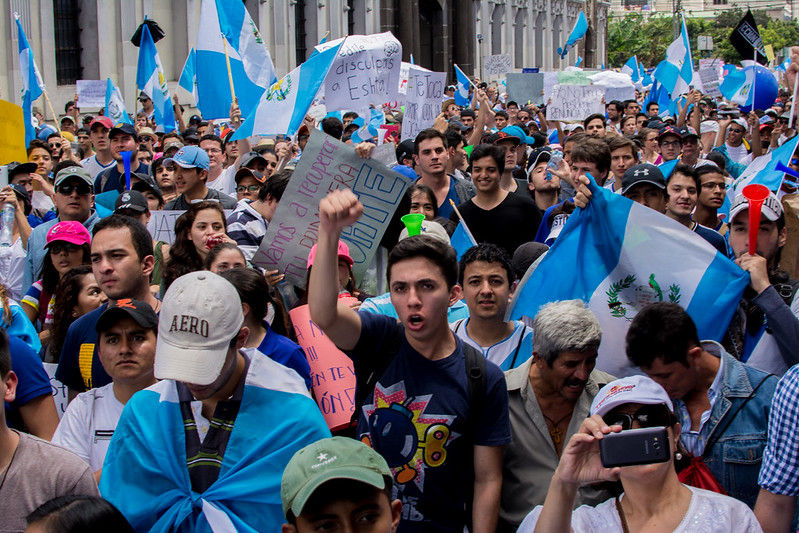
In October 2023, the five leaders led protests and a nationwide Indigenous-led strike to defend the victory of democratically elected candidate Bernardo Árevalo, who won the August 2023 presidential election, and to oppose judicial efforts to overturn the results. In April 2025, prosecutors in the Organized Crime Unit of the Attorney General’s Office of Guatemala accused Pacheco and Chaclán of terrorism, referring to their roles during the demonstration of 2023. The remaining leaders were also accused of terrioism, in addition to unlawful association, and then arrested in August 2025 and January 2026.
After more than 15 months, on September 11, 2026, a court closed the criminal proceedings against Pacheco, Chaclán, Puac, and Toc, finding insufficient grounds to continue the case. On September 25, 2026, proceedings against Elías were also closed due to lack of evidence in order to continue criminal proceedings. While the criminal proceedings have officially ended, independent news agency Prensa Comunitaria has questioned whether a public apology is enough, given the psychological and financial harm suffered by their families and communities.
Guatemala has established legal protections for Indigenous Peoples and recognizes the legitimacy of their institutions. The five leaders who were criminalized represented 48 Cantons de Totonicapán and the broader Indigenous Peoples of Guatemala through established forms of political authority, and their rights to participate in the country's democratic process. Under Article 66 of the Constitution, the country recognizes Indigenous communities and explicitly calls for the protections of their ways of living and forms of social and political organization. Guatemala is also a signatory to the International Labour Organization (ILO) Convention No. 169, which establishes protection for Indigenous People, including respect for their institutions and their active participation in decision making, particularly on issues affecting them.
Through Árevalo’s apology, the government further acknowledged the role these leaders and the broader Indigenous communities play in defending Guatemala’s democratic process. However, discussions regarding reparations from sufferers and guarantees that Indigenous authorities can represent their communities without being criminalized for peaceful political participation are needed.
Glossary
Criminal Proceedings: A formal legal process where the government prosecutes a person or entity accused of committing a crime, governed by constitutional protections and a high standard of proof.
Demonstrations: The act of showing, proving, or explaining how something works, or a public gathering where people express support for or opposition to a cause.
Judicial Action: Any action, lawsuit, claim, proceeding, or investigation (or group of related actions, lawsuits, proceedings or investigations) brought before any court or other adjudicative body.
National Strike: The stoppage of work by a substantial proportion of workers in a range of industries in an organized effort to achieve economic or political objectives.
Persecution: The systematic, cruel, or unfair mistreatment of an individual or group by another entity (such as a government or dominant social group) over a prolonged period.
Reparations: Legal and moral obligations of states or responsible entities to remedy gross violations of human rights and serious violations of international humanitarian law
Terrorism: The calculated use of violence to create a general climate of fear in a population and thereby to bring about a particular political objective.


