
Bangladeshi Garment Workers Fight for Living Wages, Exposing Supply Chain Exploitation
Author: Srijita Mukherjee
November 24, 2026
HRRC supports the workers’ urgent demand for a wage increase to counteract inflation and to allow families to afford basic necessities like food, housing and healthcare. We condemn the unfair practices of Western brands that allow a low-income country, such as Bangladesh, to bear the dangerous human and economic cost of garment production so that developed countries can profit from cheap retail.
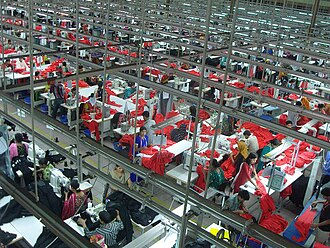
On November 1, mass protests erupted across Bangladesh as millions of garment workers took to the streets to demand a significant increase in the monthly minimum wage, currently set at about US $100. As the second-largest clothing exporter in the world, Bangladesh manufactures a significant portion of the global clothing market.
Workers from seven or eight nearby factories blocked Dhaka-Tangail highway in Gazipur's Kaliakair Upazila district, causing traffic stoppages. Police deployed tear gas shells and sound grenades to clear the highway, leaving several protesters and workers wounded. According to Md Amjad Hossain, superintendent of Gazipur Industrial Police, the protests were partly fueled by unverified rumours that a worker had died during earlier clashes with police, but the demonstrators dispute this. Their demand remained higher wages.
Behind the scenes of the protest and the highway blockage, there lies a severe human rights crisis that is driven by inflation and low wages. Workers across Bangladesh document that rising costs for food, housing, transport, and utilities have completely eroded their purchasing power. For instance, Laili Begum, a garment worker, reports that she cannot afford to keep her children in school, resulting in her 15-year-old daughter and 12-year-old son dropping out. She highlights their worsening situation, stating that they can only afford one meal a day and often go hungry, “My son is so thin that you can count every rib in his chest. What else can I do?”
Shilpi Khatun, a 27-year-old garment worker, is the breadwinner for her family, which includes her unemployed husband and her in-laws. They depend on her salary to live. She cooks on a wood fired stove since they cannot afford gas. Even after five years working in the garment industry, she struggles to afford basic necessities as rising prices make life difficult. These frustrations echo with many garment workers, leading to the protests. Roksana Parveen, a 29-year-old sewing operator in a factory in Ashulia, shared these frustrations stating, "I know my daughters should be eating better, but I just can't afford it."
The Bangladesh Garment Manufacturers and Exporters Association (BGMEA), an organization representing the factory owners, noted that protests disrupted operations at 529 factories and impacted nearly a million workers. In response, the government and factory owners established a six-member wage board to address the workers' demands. According to Reuters, the wage board agreed on November 4 to review the wage structure in December, though the extent of the increase remains undetermined.
Sheikh Hossain Muhammad Mustafiz, an official at the BGMEA and managing director of Cute Dress Industry Ltd, highlighted that fair wages and employment security can only be achieved if factories remain competitive enough to win orders from the international market. Industry manufacturers, however, have fiercely resisted wage increases, arguing that higher pay would “erode Bangladesh's cost advantage over rivals such as India and Vietnam and further squeeze margins already under pressure from higher energy costs”.
As protests continue to disrupt an apparel industry accounting for $38 billion annually and employing over four million workers in Bangladesh, official response has intensified. Citing clashes that damaged property and police vehicles, the BGMEA and the Bangladesh Knitwear Manufacturers and Exporters Association (BKMEA) threatened to boycott wage board negotiations unless factory security is guaranteed. Factory owners are leveraging the provision of Bangladeshi labor law, known as "no work, no pay", to keep facilities “indefinitely closed”. State officials have threatened punitive action against demonstrators accusing them of attempting to "destabilise the country”. Workers like Mamun, a 28-year-old factory worker, countered this framing, arguing that the protests are driven purely by survival. “The government must either bring down the prices of essential commodities or raise our wages,”
This indicates the human rights crisis as workers remain trapped in a system where they must work in hazardous and impoverished conditions to secure food and basic survival for their families only to have their fundamental right to a dignified life sidelined.
Taqbir Huda, a Clarendon Scholar at the University of Oxford and human rights lawyer, authored the Amnesty article and was featured in Al Jazeera. He articulates frustration with Western brands acquiring Bangladeshi garments without addressing workers’ human rights. He describes the Western brand’s actions as “extractive and exploitative”.
Behind the local unrest lies a global system built on exploitation. Western brands such as H&M, Zara, Levi Strauss, Walmart, and Primark, heavily rely on Bangladeshi garment exports, generating over 80% of the nation's export earnings. These Western brands set a price with the factory owners. The factory owners then hire local workers to produce garments with wages determined by the owners. While these workers contribute value through their labor, the majority of the value is captured by the Western brands that do not own the factories or employ the garment workers.
This global system forces Bangladeshi factory owners into dual roles: both the exploiters and the exploited. Pressured by international buyers to keep prices low, they pass the strain down to vulnerable workers. The owners keep wages low and threaten to blacklist or dismiss to suppress conflict. Meanwhile, Bangladeshi authorities protect this lucrative arrangement by deploying police armed with tear gas and pursue criminal charges against protesting workers rather than confronting the foreign buyers.
Glossary
Commodity: Something that is sold for money.
Counteract: To counteract something means to reduce its effect by doing something that produces an opposite effect.
Destabilize: To create a situation which reduces the power or influence of a country or government.
Erode: To destroy or remove slowly.
Exploitative: Disapproval of something because it treats people unfairly by using their work or ideas for its own advantage, and giving them very little in return.
Extractive: involving taking a resource (something valuable) or profit from something without trying to replace it or trying to avoid harming that thing
Grenade: A small bomb that can be thrown by hand.
Inflation: A general increase in the prices of goods and services in a country.
Impoverish: To make a person or a country poor.
Minimum Wage: The lowest wage that an employer is allowed to pay an employee, according to a law or agreement.
Provision: The act of giving or making something available to people who need or want it.
Protest: To say or show publicly that you object to something.
Punitive: Inflicting, involving, or aiming at punishment
Tear gas: A gas that causes eyes to sting and fill with tears so that you cannot see. It is sometimes used by the police or army to control crowds.
Wage: The amount of money that is regularly paid to them for the work that they do.
References


