The Return of Fujimorism: What Keiko Fujimori’s Presidency Means for Memory and Impunity in Peru
Author: Maria Fe Mendoza
August 21, 2026
HRRC urges the Peruvian government to ensure that efforts to combat organized crime do not come at the expense of human rights, democratic institutions, or accountability. We call for the maintenance of strong institutional checks and civilian oversight over the use of state power, particularly the involvement of the armed forces in domestic security, and for security policies that do not create conditions conducive to authoritarianism or impunity.
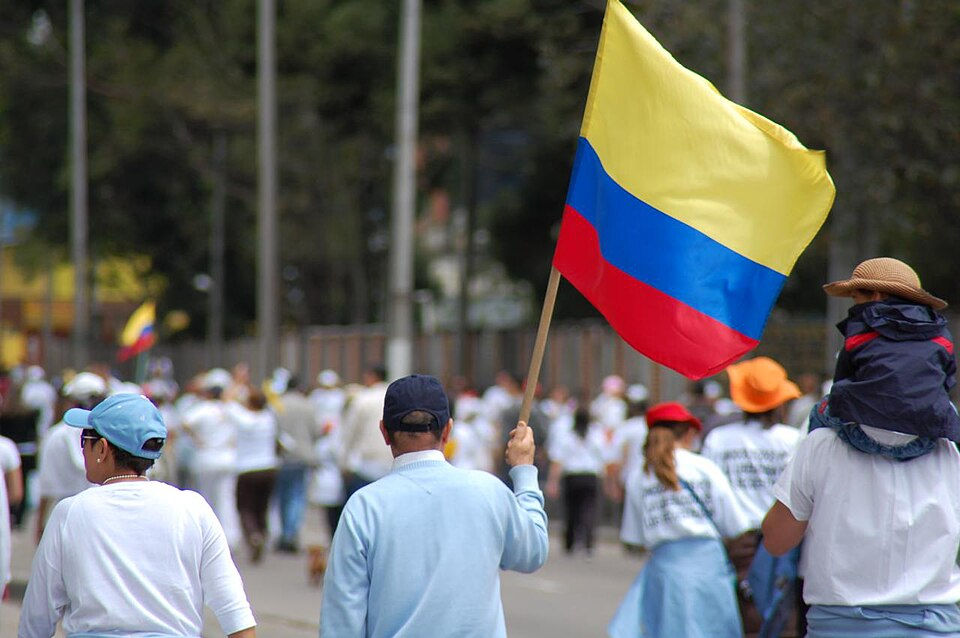
![Presidential inauguration of Keiko Fujimori [Image source: Wikimedia Commons]](https://static.wixstatic.com/media/f05ed1_c1faf3d1c88d48a2bb237e3668283aae~mv2.jpg/v1/fill/w_980,h_653,al_c,q_85,usm_0.66_1.00_0.01,enc_avif,quality_auto/f05ed1_c1faf3d1c88d48a2bb237e3668283aae~mv2.jpg)
On July 28, 2026, former president of Peru Alberto Fujimori’s daughter Keiko Fujimori narrowly defeated her opponent, Roberto Sánchez, in the presidential runoff election - making her the new president of Peru. Fujimori had reached runoffs in 2011, 2016, and 2021, making this her fourth presidential runoff. Fujimori’s historical win brings Fujimorism back to Peru more than two decades after her father’s presidency ended and after a decade of significant influence by Fuerza Popular, the political party she leads, in Congress.
Fujimori returned to power during a prolonged political crisis which has caused Peru to see eight presidents in little over a decade. Fuerza Popular has been one of the main actors in this instability, playing a central role in conflicts between Congress and the executive branch and several presidential impeachments that have shaped Peruvian politics in recent years. This institutional crisis coincides with a growing wave of violence linked to organized crime and the passage of a series of legislative reforms of which the efficacy has been called in question by organizations and experts.
During the 1990s, Alberto Fujimori headed an authoritarian human rights violating government. In 2009, Fujimori was sentenced to 25 years in prison as the indirect perpetrator of killings and serious injuries committed in the Barrios Altos and La Cantuta cases, and for the aggravated kidnapping of journalists Gustavo Gorriti and Samuel Dyer. The ruling established Alberto Fujimori’s responsibility for crimes committed by the Colina Group, a clandestine paramilitary group that operated during his government. The conviction became an emblematic case of accountability for human rights violations in Latin America.
Alberto Fujimori’s conviction did not put an end to victims’ search for justice. Forced sterilizations carried out during his government and disappearances of civilians during Peru’s internal conflict remain without a definitive judicial response for many of those affected and their families. For example, in March 2026, the Inter-American Court of Human Rights held the Peruvian state responsible for the forced sterilization and subsequent death of Celia Edith Ramos Durand and ordered the state to provide reparations to her family, nearly three decades after her death. Relatives of victims of La Cantuta, recent protests, and other episodes of state violence have joined together to demand truth, justice, and guarantees of non-repetition following Keiko Fujimori’s return to power.
For victims of human rights violations committed during Alberto Fujimori’s government, his daughter’s recent win is particularly historical as victims ability to seek justice and recognition for crimes committed during his regime is called into question.
Although Keiko Fujimori built her own political career, her trajectory remains closely tied to her father’s legacy. She was first lady during Alberto Fujimori’s second administration and later became the leading figure of the Fujimorism. During her fourth presidential campaign and her first days in office, Fujimori has placed the fight against organized crime and the restoration of “order” among her main priorities. Her proposals include the construction of a mega-prison, the involvement of the armed forces in prison control, and a greater military presence in areas affected by crime. Such measures can create conditions to authoritarianism, particularly when expanded state powers and the use of the armed forces are not accompanied by strong institutions and human rights safeguards.
These promises to strengthen Peru’s war on crime contrast with Fuerza Popular’s congressional efforts to approve laws that have been cited as ineffective for fighting crime.
Among these are the so-called “pro-crime laws”, a set of legislative amendments that have limited tools available to prosecutors and judges to investigate and prosecute criminal organizations, creating obstacles to the prosecution of corruption offenses. These measures include changes to the rules governing investigations into organized crime and restrictions on certain tools used by the Public Prosecutor’s Office. The contradiction is particularly significant: while the new government promises to give the state greater powers to confront crime, the political party now leading the executive branch has promoted legislation in Congress that has left prosecutors and judges under-resourced.
This contradiction creates an additional dimension to a political movement whose past is marked by an expansion of state power in the name of law and order. During Alberto Fujimori’s government, the fight against terrorism was used to justify policies and state operations that resulted in serious human rights violations. The challenge for the new government will not only be to demonstrate that it can effectively combat organized crime, but to do so without authoritarianism and human rights violations.
Glossary
Authoritarian – of, relating to, or favoring a concentration of power in a leader or an elite not constitutionally responsible to the people
Accountability – the quality or state of being accountable
Amendment – the process of altering or amending a law or document (such as a constitution) by parliamentary or constitutional procedure
Emblematic – of, relating to, or constituting an emblem
Executive branch – the branch of government that is charged with such powers as diplomatic representation, overseeing the execution of the laws, and appointment of officials and that usually has some power over legislation (as through veto)
Fujimorism – refers to the policies and the political ideology of former President of Peru Alberto Fujimori as well as the personality cult built around him, his policies, and his family, especially Keiko Fujimori, the current President of Peru.
Impeachment – a calling to account for some high crime or offense before a competent tribunal
Impunity – exemption or freedom from punishment, harm, or loss
Instability – the quality or state of being unstable
Non-repetition – Absence of repetition; failure to repeat.
Obstacle – something that impedes progress or achievement
Organized crime – a group of professional criminals who work together as part of a powerful and secret organization
Paramilitary – of, relating to, being, or characteristic of a force formed on a military pattern especially as a potential auxiliary military force
Prolonged – continuing for a notably long time : extended in duration
Prosecutor – a person who institutes a prosecution before a court
Rule of law – a situation in which the laws of a country are obeyed by everyone
Sterilization – the act or process of sterilizing
Trajectory – a path, progression, or line of development resembling a physical trajectory
References