
Repression, Sanctions, and Economic Challenges: Cuba’s Deepening Human Rights Crisis
Author: Anonymous
August 12, 2026
![Cuban protesters at the White House [Image credit: Joe Flood/Flikr]](https://static.wixstatic.com/media/f05ed1_83f4b9d11f8146d4a3a263ab0b5b5203~mv2.jpg/v1/fill/w_800,h_600,al_c,q_85,enc_avif,quality_auto/f05ed1_83f4b9d11f8146d4a3a263ab0b5b5203~mv2.jpg)
Cuba is facing a rising human rights crisis due to its long-standing political repression, U.S. economic sanctions, the COVID-19 pandemic, and recent cuts on Venezuelan oil supplies. These challenges together have caused a substantial economic crisis characterized by continuous economic decline, severe supply-chain disruptions, shortages of food and medicines, and worsening basic infrastructure, such as electricity, water, healthcare, education, and transportation services. These conditions have combined to increase humanitarian hardships, cause forced migration, and may ultimately result in a catastrophic outcome for Cuba.
Historical Background
Political context
After Cuba obtained independence from the Spanish Empire in 1902, its politics and economy have been significantly influenced by U.S. policies. For example, from 1905 to 1929, the U.S. military intervened multiple times to suppress coups, quell uprisings, and facilitate elections (Aljazeera, 2009). In 1959, following a six-year conflict, Communist insurgents under Fidel Castro ousted U.S.-backed President Fulgencio Batista. After the revolution, Fidel Castro ruled the nation for nearly 50 years before handing over power to his brother, Raul, in 2008. Castro's government created a one-party state, redistributed land, nationalized most of the economy and executed thousands of opponents in the decade following its rise to power. However, it also provided free education and healthcare for its citizens (Aljazeera, 2014).
Earlier U.S. Sanction and Its Implications
U.S. sanctions are one of the substantial contributors to Cuba's economic challenges, which significantly affect the daily living of Cubans. In 1962, after the Cuban Missile Crisis, the U.S. froze all Cuban assets subject to the Cuban Assets Control Regulations (CACR), prohibited all financial and commercial transactions, banned Cuban exports to the U.S., and barred any individual or entity from the U.S. or a third country from engaging in transactions in U.S. dollars with Cuba (UNHRC, 2025).
Congress has implemented several sanctions (Export Administration Regulations of 1979, Torricelli Act of 1992, LIBERTAD Act of 1996, and the Trade Sanctions Reform and Export Enhancement Act of 2000) to restrict trade, foreign assistance, exports, and access to international financial institutions (CRS, 2018). Since the U.S. has maintained its policy of isolation toward Cuba, which includes a state-sponsored terrorism designation and a decades-long embargo (UNHRC, 2025), the situation has remained tense.
Sanctions serve as an effective political instrument of coercion, which has a significant negative effect on the gross domestic product (GDP) growth rate and its components (consumption and investment), as well as on trade and foreign direct investment (Gutmann et al., 2023). Such impact is achieved by increasing the national risk of a sanctioned country, reducing the stability of its exchange rate, and restricting its international trade (Liu et al., 2024). U.S. sanctions are especially detrimental due to their extraterritorial reach, the global significance of the U.S. economy, the strength of the dollar as a global currency, and the collateral damage they can cause with minimal international political consensus (Gutmann et al., 2023). A statistically significant relationship exists between changes in U.S. remittances, tourism, and goods flows and projected growth of Cuba's gross domestic product (Vidal, 2025).
Over the last thirty years, Cuba has developed alternative economic strategies by establishing trade agreements, commercial relations, and investments with other countries to manage its expenses and investments (Vidal, 2025). For example, Cuba imports petroleum and agricultural products from Venezuela, while it exports laboratory reagents, electric batteries, and rolled tobacco. China has imported mineral ores from Cuba and supplied autos, motorcycles, electrical equipment, and other manufactured items. Spain has long been a significant trading partner in Europe, exporting industrial apparatus, engines, beverages, and aircraft parts while also importing Cuban tobacco and rum (OEC, 2026). Even though these partnerships have assisted Cuba in alleviating the consequences of economic isolation, they are unable to completely mitigate the overall devastating impact of U.S. sanctions.
Negative Drivers of the Cuban Economy
COVID-19
Cuba was hit hard by the COVID-19 pandemic's financial crisis because the island nation is heavily reliant on tourism and remittances.
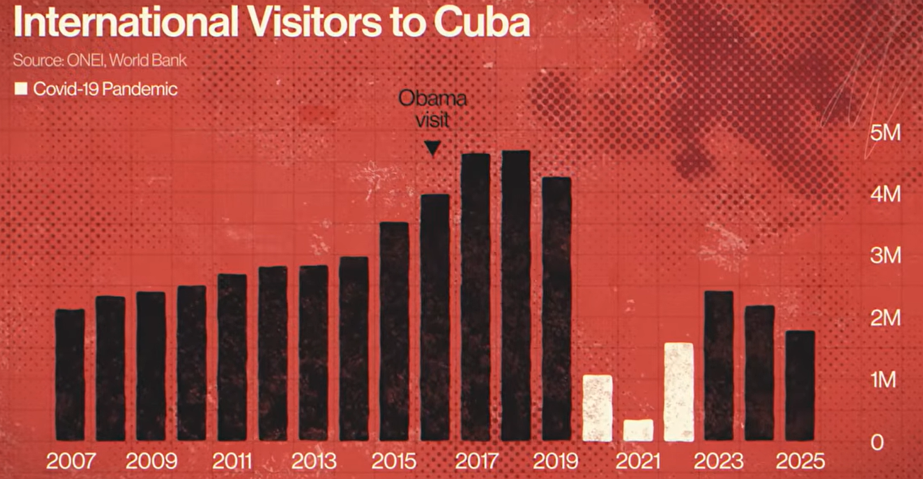
International tourist arrivals decreased from 4.276 million in 2019 to 1.086 million in 2020, indicating an estimated 75% loss in foreign visitors (ISI, 2020). Although tourism gradually recovered to 2.2 million visitors by 2024, arrivals remained significantly lower than the pre-pandemic levels (Fig. 1) (ONEI, 2026).
Also, nearly 50,000 Cubans annually bring home approximately $8 billion in cash remittances and products from their travels abroad, approximately eight percent of Cuba's GDP (Bastian & Garth, 2020). However, regular remittance flows decreased by approximately 37% in 2020 and 54% in 2021 due to the dual impact of U.S. remittance restrictions and the COVID-19 pandemic, notably the cessation of international flights that hindered both formal and informal movement (CIFFRA, 2023).
Cuba's economic crisis has persisted since the Soviet Union's collapse and the subsequent loss of Soviet subsidies, resulting in recurring shortages of essential goods such as food, fuel, and other necessities (Aljazeera, 2023). The COVID-19 pandemic also disrupted international trade, reducing Cuba's export earnings and ability to import food, fuel, medicines, and other essential goods. As a result, 12.8% (1.4 million people) of Cubans did not meet the daily 2,100-calorie threshold in 2023 (Zahniser et al., 2024). Overall, the statistic indicates that Cuba's economy has not recovered from the COVID-19 pandemic, with three successive years of negative growth from 2023 to 2025 (Fig. 3). With a rapidly aging population and continuously low birth rates, Cuba's economic prospects are likely to worsen further.
Disruption of Venezuelan Oil Supplies
Cuba has historically depended on Venezuelan oil. Rooted in a 2000 pact, Cuba relied on Venezuela to provide tens of thousands of barrels of oil per day on highly preferential terms. In return, Cuba supplied tens of thousands of medical professionals, sports trainers, and security and intelligence advisors (Bloomberg Originals, 2026). In 2025, Cuba imported an average of 1.2 million barrels of oil monthly, leading to a total of 13.7 million barrels for the year, but no crude oil supplies were received in January and February 2026 (S&P Global, 2026).
The 2026 U.S. military intervention in Venezuela, which led to the capture of Nicolás Maduro and the subsequent blockade of Venezuelan oil supplies to Cuba, is causing a severe energy shortage (Fig. 2) (AS/COA, 2026) that is severely impacting electricity, water, food, and essential public health services (Center for Strategic and International Studies [CSIS], 2026). Mexico, having emerged as an alternative source, also ceased oil shipments to Cuba following the US's threat of sanctions (Aljazeera, 2026a).
The minister of energy, Vicente de la O, stated, "We have no fuel, no more reserves.” The state electric utility is struggling to deliver even a few hours of electricity daily, while temperatures rise into 95°F with 75% humidity, adversely affecting overnight sleep (Guardian, 2026b). Furthermore, nearly 3 million Cubans face water shortages every day because 84% of water pumping equipment depends on electricity (AP, 2026b).

Recent U.S. sanctions
After years of sanctions-based strategy, in 2014, President Obama announced a significant change in U.S. policy, transitioning from the long-standing sanctions-based policy to a policy of engagement and a normalization of relations. However, he admitted that since the embargo is legally binding, he lacked the power to lift it (CRS, 2018).
In 2017, President Trump reversed parts of President Obama's policy of improving relations with Cuba. For example, he prohibited Americans from engaging with Cuban enterprises associated with the military and terminated individual ("people-to-people") travel to Cuba. By 2019, the Trump administration had essentially abandoned engagement and imposed additional sanctions, mainly on travel and remittances (CRS, 2018).
Later in 2022, the Biden administration announced several policy reforms to boost support for the Cuban people, such as expanded visa processing, eased travel restrictions, eased restrictions on sending cash remittances, etc. (CRS, 2025a). More specifically, he proposed rescinding Cuba's State Sponsor of Terrorism (SSOT) status and reversing Trump's 2017 National Security Presidential Memorandum 5 (NSPM-5), which required the Secretary of State to identify the "Cuba restricted list" of Cuban military, intelligence, and security firms and prohibit direct financial transactions with them. NSPM-5 additionally reinforced the U.S. tourism prohibition to Cuba and expanded Cuban government official restrictions (CRS, 2025b).
Again in 2025, President Trump classified Cuba as a state sponsor of terrorism (SSOT), a designation that had previously been rescinded by Biden. He also revoked President Biden's January 14 presidential memorandum that revoked NSPM-5. Secretary Rubio informed Congress in January 2025 that he had withdrawn President Biden's suspension of Title III of the LIBERTAD Act actions (CRS, 2025b).
Economic Challenges
Cuba is currently experiencing its most severe economic decline since the Castro regime seized power. The COVID-19 pandemic, new U.S. economic sanctions, and disruptions to Venezuelan oil supplies have significantly affected tourism, exports, and remittances, further worsening the country's economic conditions.
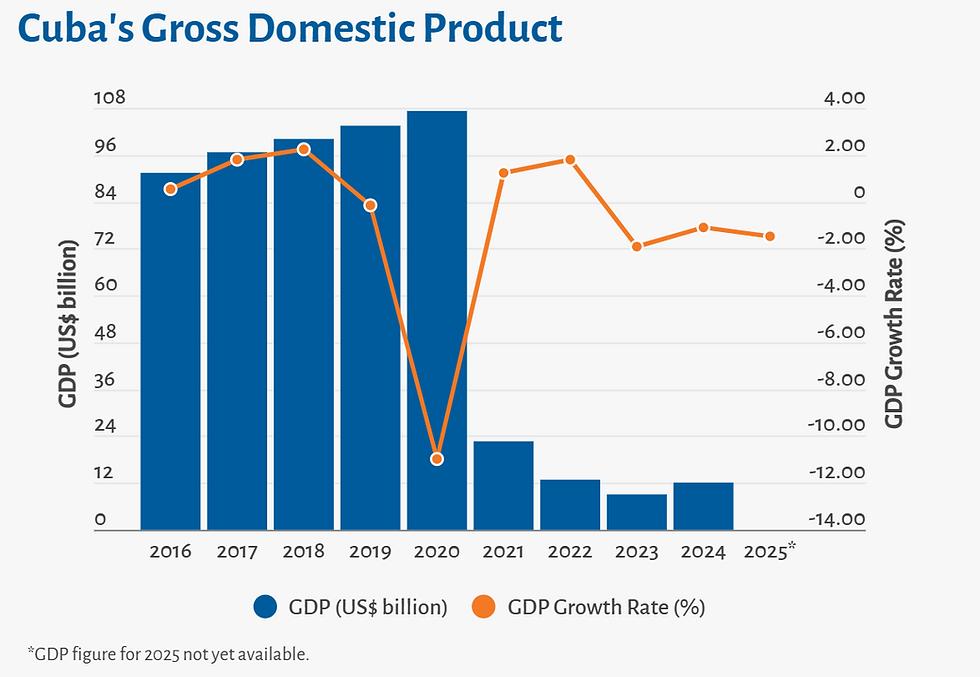
The GDP of Cuba has experienced slow growth since 2016; however, it saw a sharp decline after 2020 and has not returned to pre-pandemic levels (Fig. 3). Following a contraction of -10% in 2020, GDP growth has remained negative since 2023 (Fig. 3). The United Nations Economic Commission for Latin America and the Caribbean (ECLAC) predicted that the island's economy would contract by 6.5 percent in 2026 (Atlantic Council, 2026).
Inflation has remained persistently high since Cuba's 2021 monetary reform, rising to a peak of approximately 77.3% in late 2021. It remained elevated at approximately 39.1% (2022), 31.3% (2023), 24.9% (2024), and 18.3% (2025), suggesting that inflation has grown into a long-term structural challenge rather than a short-term shock (Focus Economics, 2026).
The Cuban peso has also undergone substantial depreciation. The informal exchange rate has been going from approximately 35–40 CUP/USD in early 2021 to over 170 in 2022, 265 in 2023, more than 330 in 2024, 400 in 2025, and more than 600 CUP/USD in mid-2026 (CIBERCUBA, 2026). However, the official exchange rate remains 24 pesos per U.S. dollar (AS/COA, 2026).
As of May 2026, monthly cargo vessel arrivals and departures have decreased by 75% compared with 2019 (Atlantic Council, 2026). The fiscal deficit also increased substantially, from 3.6% of GDP in 2010–2016 to 10.2% from 2017 to 2020.
Trade performance has deteriorated considerably. In 2024, the value of exports was USD 2,128 million, while the deficit was USD 5,368 million. Export earnings from major commodities—including tobacco, sugar, nickel, and zinc—declined from USD 1.6 billion in 2018 to USD 992 million in 2024.
The economic crisis has also severely affected household livelihoods. The average monthly earning is only $16, while 89% of households are estimated to be living in extreme poverty. The national currency is experiencing regular devaluations, which influence the prices of essential items, resulting in uncertainty and adversely affecting individuals' livelihoods (UN, 2025). According to the United Nations, the economic losses incurred from only two hours of oil supply disruption (approximately USD 1.4 million) are equivalent to the cost of psychiatric, neurological, and cardiovascular medicines, as well as specialized meals for children with hereditary and endocrine metabolic disorders (UN, 2025).
Tourism is one of Cuba's largest sources of foreign exchange and accounted for approximately 35.7% of GDP in 2024 (World Bank, 2024). The number of international visitors has gradually declined from 2.4 million in 2023 to 1.8 million in 2025 (Fig. 1), likely due to frequent blackouts and problems in water supply affecting hotels, restaurants, and guesthouses (AS/COA, 2026).
Remittances remain another major form of income in the country (Aljazeera, 2026a), and the remittances sent by family members abroad are usually exempt from U.S. unilateral sanctions. The average annual growth of remittances from 1994 to 2020 has been 9.6%. However, receiving remittances became more difficult after Western Union's operations stopped in 2025 (UNHRC, 2025). Two hundred foreign banks and financial institutions have terminated their relationships with Cuba since 2021 because of Cuba's designation as a State Sponsor of Terrorism (SSOT). Even UN institutions like UNESCO have been hesitant to assist Cuba due to concerns over potential funding reductions from the U.S. (Escobedo et al., 2026).
Continuous GDP decline, persistently high rate of inflation, rapid devaluation of the Cuban peso, growing trade deficits, declining export revenues, acute foreign-exchange shortages, and a 75% decrease in cargo vessel traffic have severely limited Cuba's ability to import basic necessities and support its economic activities.
Human Rights Consequences
Right to food
Food insecurity continues to be a major challenge in Cuba because of its persistent economic crisis, fuel shortages, restrictions on international markets, and limited access to essential agricultural inputs and services (World Food Programme [WFP], 2025).
Cuba imports almost 80% of its food, primarily depending on the European Union, the U.S., and Brazil for agricultural supplies (Zahniser et al., 2024). The limited availability of foreign currency has considerably affected the supply of both domestic and imported food (WFP, 2026).
The average monthly pay ranges from $12 to $16, while a tray of 30 eggs costs $6. Most individuals depend on the national food ration system established six decades ago. The ration system provides access to essential items like rice, oil, beans, and sugar to families, yet stores are frequently severely understocked. The government has reported shortages and delays in its distribution (WFP, 2026). In addition, the United Nations World Food Programme (WFP) has cautioned that the current conflict between the United States and Iran endangers millions of individuals with hunger (Aljazeera, 2026b).
Alarmingly, 70% of the Cuban population skipped meals due to higher food prices and lack of resources. Only fifteen percent of the population can consistently maintain three daily meals, with the elderly, the unemployed, and those without remittances most affected (CSIS, 2026).
Food shortages pose a substantial threat for newborns, young children, and pregnant women, resulting in impaired growth and development, which ultimately compromise the immune system and increase the risk of illnesses and infections (Escobedo et al., 2026). Therefore, the Cuban government has requested assistance from the UN World Food Program to maintain its two-meal-a-day program for the most vulnerable and elderly citizens, as the situation remains critical.
Right to health and essential services
The healthcare system in Cuba, which was once an example of international cooperation and competence, is now reportedly collapsing (Ghebreyesu, 2026).
The hospitals throughout Cuba are now experiencing severe medicine shortages due to persistent foreign currency shortages, reduced imports, supply chain disruptions, and the broader economic crisis (WHO, 2024). The health system is struggling to maintain lifesaving apparatus and is suspending surgeries as the country's healthcare system is in severe crisis due to blackouts and fuel shortages. Affected areas include maternity and child health, as well as emergency care, blood banks, laboratories, and vaccination programs.
Approximately five million individuals suffering from chronic illnesses face potential disruptions of essential treatments; over 100,000 patients, including 11,000 children, are currently awaiting surgeries that have been postponed due to shortages of medicines, oxygen, and anesthetics as well as power outages and supply shortages (UN News, 2026). The survival rate for pediatric cancer has fallen from 80% to 65% (Ghebreyesu, 2026). About 32,800 pregnant women face the persistent risk of delivering during frequent blackouts and prolonged power outages, with increased maternal anxiety (BBC, 2026).
Right to education
The oil blockade has a significant impact on fundamental rights of education, just as it does on other services like food and health, affecting about one million students (UNESCO, 2026). For example, 22-hour blackouts in Havana and worse elsewhere in the country disrupt children from sleeping well, especially in the heat, making it particularly difficult for them to attend school the next day. Therefore, the Ministry of Education gradually closed the academic year starting June 15, realizing that in-person classes are unsustainable for students and staff who stay without power for nights (UPI, 2026).
The main campus of the University of Havana was shuttered in February 2026, while students have been directed to attend sessions online. As blackouts expand in both scope and duration, the possibility of online programs has diminished, particularly for rural students who lack the necessary infrastructure (TRIBUNO del PUEBLO, 2026).
A small group of students protested the blackout and financial crisis on campus and explicitly stated, "We aren’t martyrs for any side; we are university students. So, none of us intended to be here, but there has been no other way,” while declining to provide their identity for fear of government reprisals (AP, 2026).
In addition to this blackout crisis, previous hydrometeorological and seismic events have impacted school infrastructure, requiring urgent assistance for 2,000 schools, alongside a projected shortfall of 26,000 teachers (UNESCO, 2026). Anne Lemaistre, the head of the UNESCO Regional Office in Havana, cautioned that "the future of an entire generation is jeopardized, with long-term consequences."
Cuban Government Repression
The Cuban communist government continues to repress and prosecute dissenters for speaking about the economic crisis, deteriorating living conditions, shortages of resources, ongoing blackouts, and a significant increase in internet costs.
Authorities indiscriminately detain, mistreat, and intimidate political rivals, journalists, independent activists, and critics, while as of 2025 they imprison roughly 700 political prisoners, with hundreds more subjected to house arrest or other restrictions. Even the relatives of these inmates experience harassment by authority. In addition, released protesters remain under constant surveillance. Prisons are overcrowded, unsanitary, and lack food and water, and custodians die from lack of medical treatment, abuse, and carelessness (Human Rights Watch [HRW], 2025).
Violations in Cuba establish an institutional framework aimed at suppressing women's political participation, freedom of expression, and independent organization through the criminalization of activism, arbitrary detentions, unlawful surveillance, physical and psychological violence, and the strategic exploitation of motherhood and family life as tools of intimidation.
The tactics also include physical assaults during peaceful assemblies, criminal charges, unfair trials, judicial intimidation, enforced disappearances, de facto house detention, harassment, threats, acts of repudiation, and organized disinformation campaigns (Amnesty International, 2026). The government regulates all media, limits access to external information, and suppresses critics and independent journalists, while substantially raising internet costs (HRW, 2025).
A competent democratic administration is commonly linked to enhanced public accountability and the safeguarding of civil rights. Every year, the Economist Intelligence Unit publishes a democracy index that measures the extent to which citizens can choose their political leaders in free and fair elections, enjoy civil liberties, prefer democracy to other political systems, participate in politics, and have a functioning government that acts on their behalf. In 2024, Cuba was placed 33rd among 202 countries, scoring 2.58 points out of 10, while the U.S. scored 7.85 points (Our World in Data, 2024). This score suggests that the country's future progress and general welfare of its citizens may be compromised by persistent restrictions on civil liberties and political participation.
An IMF Working Paper empirically assesses the impact of political instability on economic growth, revealing that increased levels of political instability correlate with lower growth rates of GDP per capita (Aisen & Veiga, 2010). Donald Grasse argues in an article that the developmental persistence of poverty in Cambodian villages located in more repressive zones during the Democratic Kampuchea (DK) regime is due to low human capital, as the regime targeted educated members of society, leading to a skill gap between generations (Grasse, 2024). Autocrats tend to use selective repression rather than mass killings during economic growth and social unrest, which may temporarily boost regime control but undermine long-term authoritarian resilience (Li, 2026). Conversely, democracy reduces the likelihood of nations encountering severely adverse economic consequences (Knutsen, 2021).
Forced Migration
Life in Cuba has been difficult for many years, particularly following the collapse of the Soviet Union in 1991. Lack of necessities such as food, housing, electricity, and internet are some examples that are driving Cubans to leave the country (Guardian, 2026a).
Since the Cuban Revolution of 1959, many Cubans have fled to the U.S. to find financial stability and political freedom. U.S. immigration rules initially offered favorable humanitarian safeguards and avenues for permanent residency through status adjustment; however, these policies have since tightened, limiting legal migration alternatives.
Since the 1960s, nearly all Cubans entering the U.S. have received legal admission, primarily as refugees. Over 60 years, Cubans have continued to migrate to the U.S. as political refugees, fleeing a communist dictatorship. According to 2020 estimates from the United Nations Population Division, the U.S. was by far the principal destination for Cubans living abroad (MPI, 2023). Cuba represents the third-largest Hispanic demographic in the U.S., following Mexicans and Puerto Ricans (Pew Research Center, 2026) (Fig. 4).
Figure 4. (a) shows the Cuban population in the US from 1980 to 2024, while (b) illustrates immigration waves from 1950 to 2020, highlighting a spike after the 2021 protest (Source: Pew Research Center, 2026).
The Cuban Adjustment Act of 1966, as revised, and U.S.-Cuban migration agreements settled in the mid-1990s, which functioned in parallel with the Immigration and Nationality Act (INA), shaped U.S. policy on Cuban migration (Congressional Research Service, 2016). The Cuban Adjustment Act of 1966 allows Cubans to apply for permanent residency in the U.S. upon meeting specific eligibility criteria (U.S. Citizenship and Immigration Services [USCIS], 2026). Furthermore, they can obtain permanent resident status through eligible U.S.-based relatives who are U.S. citizens.
However, U.S. policies have become more restrictive in recent years. In 1995, the Clinton administration adopted the wet-foot/dry-foot policy, which authorized the return of Cubans intercepted at sea while generally letting those who reached U.S. soil remain (Congressional Research Service, 2016). In 2017, the administration discontinued this program, which eliminated automatic preferential entry for Cuban migrants (White House, 2017), and it has not been reinstated under Trump's first term, Biden's administration, or Trump's second term.
The Biden administration established the Cuba, Haiti, Nicaragua, and Venezuela Parole Program (CHNV) humanitarian parole program, allowing immigrants from Cuba, Haiti, Nicaragua, and Venezuela to work and live in the U.S. (American Immigration Council, 2025). However, in 2025, the Trump administration terminated the CHNV program and discontinued other initiatives that provided temporary deportation protection for Cubans (Federal Register, 2025). Nevertheless, the ongoing litigation has resulted in the court blocking Trump's attempt to revoke the legal status of CHNV migrants (CEDA, 2026).
As a result of these legislative changes, the number of undocumented Cuban immigrants in the U.S. has increased substantially, particularly since 2017. Currently, approximately 675,000 undocumented Cubans reside in the U.S. (Pew Research Center, 2026), and 4,300 have already been deported to Mexico (HRW, 2026).
Forced migration from Cuba has an impact within Cuba as well. More Cubans may find themselves isolated in a nation already struggling with a shortage of food, fuel, medicine, energy, and water. Families that may otherwise look for assistance elsewhere may face more humanitarian pressure because of increased competition for limited resources.
Conclusion
U.S. sanctions against Cuba are meant to cause hunger and desperation within society; yet internal corruption and mismanagement of the communist regime are likely to be the major contributing factors of the crisis (Aljazeera, 2022). Cuba disputes the lack of supplies due to the ongoing U.S. embargo and the subsequent imposition of stricter sanctions. Nonetheless, the issue is mainly rooted in economic and political mismanagement and failures that stretch back to 1962.
Cuban authorities continue to use the US embargo as a justification for their illegal activities. The United Nations (UN) General Assembly and the UN Human Rights Council have consistently advocated for the removal of the sanctions (Escobedo et al., 2026). However, Washington's goal is to force the socialist government to open the economy and implement political reforms.
A combination of an offer of humanitarian assistance and ongoing economic and political pressure remains a strategy for the U.S. to gain some form of control, but it has also resulted in ambiguity regarding its overall impact on Cuba's human rights and humanitarian situation. Finally, in Cuba, the search for freedom frequently comes at the cost of food, education, human rights, and other necessities of existence. In consequence, a harsh reality is that the Cuban people are the primary victims who are constantly paying the price. The international community must speak out now to demand the end of sanctions on life-sustaining supplies, the creation of humanitarian channels, and the end of restrictions as a violation of human rights.
Glossary
AS/COA (Americas Society/Council of the Americas) - A U.S.-based organization that provides research and analysis on economic, political, and social developments in Latin America.
Blackout - A temporary interruption of electricity supply
CHNV Parole Program - A humanitarian parole program introduced by the United States in 2023 for eligible migrants from Cuba, Haiti, Nicaragua, and Venezuela.
Communism - A political and economic system in which the state controls major industries and resources, with the goal of creating a classless society.
Cuban Adjustment Act (CAA) - A U.S. law enacted in 1966 that allows eligible Cuban nationals to apply for lawful permanent residence after meeting certain requirements.
Cuba missile crisis- In 1962, the Soviet Union deployed nuclear weapons in Cuba, bringing the U.S. and the Soviet Union close to nuclear war, known as the Cuban Missile Crisis.
Embargo - A government-imposed restriction on trade and financial transactions with another country.
Exchange Rate - The value of one country's currency compared to another country's currency.
Fiscal Deficit - The amount by which government spending exceeds government revenue during a specific period.
Food Insecurity - A condition in which people lack reliable access to sufficient, safe, and nutritious food.
GDP (Gross Domestic Product) - The total value of all goods and services produced within a country during a given period. It is a common measure of economic performance.
Helms–Burton Act - A U.S. law enacted in 1996 that strengthened and expanded economic sanctions against Cuba.
Humanitarian Assistance - Aid provided to address urgent human suffering caused by crises, disasters, or conflicts.
Inflation - A sustained increase in the prices of goods and services, which reduces purchasing power.
Migration - The movement of people from one place or country to another, either temporarily or permanently.
One-Party State - A political system in which a single political party holds exclusive control over government institutions.
Parole (U.S. Immigration) - Temporary permission granted by the U.S. government that allows an individual to enter and remain in the country for a specific purpose or period.
Political Prisoner - A person detained or imprisoned primarily because of their political beliefs, activities, or expression.
Remittances - Money sent by migrants to family members or others in their country of origin.
Sanctions - Economic or political measures imposed by one country or group of countries to influence the behavior of another country.
State Sponsor of Terrorism (SSOT) - A designation used by the United States for countries determined to have repeatedly supported acts of international terrorism.
Torricelli Act (Cuban Democracy Act) - A U.S. law enacted in 1992 that strengthened restrictions on trade with Cuba.
Wet-Foot, Dry-Foot Policy - A former U.S. immigration policy (1995–2017) under which Cubans intercepted at sea were generally returned, while those who reached U.S. soil were typically allowed to remain.
References
Aisen, A., & Veiga, F. J. (2010). How Does Political Instability Affect Economic Growth? https://www.imf.org/-/media/websites/imf/imported-full-text-pdf/external/pubs/ft/wp/2011/_wp1112.pdf
Aljazeera. (2014). Country profile: Cuba. https://www.aljazeera.com/features/2014/3/19/country-profile-cuba
Aljazeera. (2023). Cuba: A deserted revolution? | Talk to Al Jazeera: In the Field. https://www.youtube.com/watch?v=mz2X0E9novk
Aljazeera. (2022). Cuba: Protesters move from social media to the streets | The Listening Post. https://www.youtube.com/watch?v=ohZJRb_79no
Aljazeera. (2009). Cuba: Timeline of a revolution. https://www.aljazeera.com/news/2009/7/26/cuba-timeline-of-a-revolution
Aljazeera. (2026a). US to allow Venezuelan oil sales to Cuba as alarm grows in the Caribbean. https://www.aljazeera.com/news/2026/2/26/us-to-allow-venezuelan-oil-sales-to-cuba-as-alarm-grows-in-the-caribbean
Aljazeera. (2026b). Will Cuba be forced to accept President Trump’s demands? | Inside Story. https://www.youtube.com/watch?v=0ZGfbyD1YlY
Aljazeera. (2026c). US-Iran war pushing millions into food crisis, warns UN. https://www.aljazeera.com/news/2026/6/5/us-iran-war-pushing-millions-into-food-crisis-warns-un
American Immigration Council. (2025). The Biden Administration’s Humanitarian Parole Program for Cubans, Haitians, Nicaraguans, and Venezuelans: An Overview. https://www.americanimmigrationcouncil.org/fact-sheet/biden-administrations-humanitarian-parole-program-cubans-haitians-nicaraguans-and
Amnesty International. (2026). Cuba: Findings, Cases and Recommendations from the Report They Want Us Silent, but We Keep Resisting. https://www.amnesty.org/en/documents/amr25/0979/2026/en/
AP. (2026a). Students stage a sit-in at Havana University as Cuba’s energy crisis slashes classes. https://apnews.com/article/cuba-student-protest-university-oil-blockade-d5eb4d4333edc8ac1906caee49895232
AP. (2026b). Water shortages worsen across Cuba as oil supplies dwindle. https://apnews.com/article/cuba-water-shortages-oil-fuel-us-blockade-4cffcda6aa913ef5e4540b91b1568e3b
AS/COA. (2026). Seven Charts on Cuba’s Economic Woes. https://www.as-coa.org/articles/seven-charts-cubas-economic-woes
Atlantic Council. (2026). The collapse of Cuba’s state-run economy is years in the making.
Bastian, H., & Garth, H. (2020). Cuban Food Security in a Time of COVID-19. Anthropology News.
BBC. (2026). Cuba’s mothers-to-be prepare to give birth in a country plunged into darkness. https://www.bbc.com/news/articles/cn53we5vll5o
Bloomberg Originals. (2026). Can Cuba’s Economy Survive Trump? [Video recording]. https://www.youtube.com/watch?v=Q0PnVLUeFI8
CEDA. (2026). Cuban Mother’s Deportation Alarms Cuban Americans, while Trump Plans to Expand Third-Country Expulsions. https://www.weareceda.org/en/us-cuba-news-brief/may9-cuban-mother-deported-967tp
CIFFRA. (2023). Policy Note N 15 Recommendation on Remittances. efaidnbmnnnibpcajpcglclefindmkaj/https://www.cepal.org/sites/default/files/project/files/ude-a2023-03-23-ndep-15-cuba-recommonremittances-eng.pdf
Congressional Research Service. (2016). U.S. Policy on Cuban Migrants: In Brief. chrome-extension://efaidnbmnnnibpcajpcglclefindmkaj/https://www.congress.gov/crs_external_products/R/PDF/R44714/R44714.3.pdf
CRS. (2018). Cuba Sanctions: Legislative Restrictions Limiting the Normalization of Relations. https://www.everycrsreport.com/reports/R43888.html
CRS. (2025a). Cuba: U.S. Policy Overview. https://www.congress.gov/crs-product/IF10045
CRS. (2025b). U.S. Cuba Policy: Recent Developments and the 119th Congress. https://www.congress.gov/crs-product/IN12499
Center for Strategic and International Studies (CSIS). (2026). Preparing for the Consequences of Collapse in Cuba. https://www.csis.org/analysis/preparing-consequences-collapse-cuba
Escobedo, A. A., De Armas, Y., Jonas, P., & Choonara, I. (2026). Impact of economic sanctions on child health in Cuba. BMJ Paediatrics Open, 10(1), e004510. https://doi.org/10.1136/bmjpo-2026-004510
Federal Register. (2025). Termination of Parole Processes for Cubans, Haitians, Nicaraguans, and Venezuelans. https://www.federalregister.gov/documents/2025/03/25/2025-05128/termination-of-parole-processes-for-cubans-haitians-nicaraguans-and-venezuelans
Ghebreyesu, T. A. (2026). Cuba: The collapse of a healthcare system. An appeal to the medical community and international institutions. Recenti Progressi in Medicina, 117(4), 167–168. https://doi.org/10.1701/4674.46886
Guardian. (2026a). History will tell’: As US pressure grows, Cuba edges closer to collapse amid mass exodus. https://www.theguardian.com/global-development/2026/jan/10/cuba-regime-polycrisis-collapse-exodus-economy-migration-us-sanctions-trump
Guardian. (2026b). No electricity, no gas, no sleep: Cubans on edge amid endless outages. https://www.theguardian.com/world/2026/jun/08/cuba-power-outages-electricity
Grasse, D. (2024). State Terror and Long-Run Development: The Persistence of the Khmer Rouge. American Political Science Review, 118(1), 195–212. https://doi.org/10.1017/S0003055423000382
Gutmann, J., Neuenkirch, M., & Neumeier, F. (2023). The economic effects of international sanctions: An event study. Journal of Comparative Economics, 51(4), 1214–1231. https://doi.org/10.1016/j.jce.2023.05.005
HRW. (2025). Cuba Events of 2024. https://www.hrw.org/world-report/2025/country-chapters/cuba
HRW. (2026). Cubans, Many in the US for Decades, Deported to Mexico. https://www.hrw.org/news/2026/05/27/cubans-many-in-the-us-for-decades-deported-to-mexico
ISI. (2020). Cuba CU: International Tourism: Number of Arrivals. https://www.ceicdata.com/en/cuba/tourism-statistics/cu-international-tourism-number-of-arrivals
Knutsen, C. H. (2021). A business case for democracy: Regime type, growth, and growth volatility. Democratization, 28(8), 1505–1524. https://doi.org/10.1080/13510347.2021.1940965
Li, S. Y. J. (2026). From killing many to targeting few: Economic growth and selective repression in Taiwan’s White Terror period. Japanese Journal of Political Science, 27(2), 99–126. https://doi.org/10.1017/S1468109925100212
Liu, X.-Y., He, W., Duan, H.-P., & Fan, R. (2024). The impact of financial sanctions on economic policy uncertainty: Global evidence. Pacific-Basin Finance Journal, 88, 102558. https://doi.org/10.1016/j.pacfin.2024.102558
Miami Herald. (2026). Cuba accepts $100 million U.S. aid offer as country says it has run out of oil Read more at: Https://www.miamiherald.com/news/nation-world/world/americas/cuba/article315759619.html#storylink=cpy. https://www.miamiherald.com/news/nation-world/world/americas/cuba/article315759619.html
MPI. (2023). Cuban Immigrants in the United States. https://www.migrationpolicy.org/article/cuban-immigrants-united-states-2021
ONEI. (2026). Cuba received 8.6% fewer international stopover visitors in December. https://tourismanalytics.com/expertinsights/cuba-received-86-fewer-international-stopover-visitors-in-december
Our World in Data. (2024). Democracy Index, 2024. https://ourworldindata.org/grapher/democracy-index-eiu
Pew Research Center. (2026). 10 facts about Cubans in the U.S. https://www.pewresearch.org/short-reads/2026/05/07/10-facts-about-cubans-in-the-u-s
TRIBUNO del PUEBLO. (2026). Cuba’s Education in Crisis: Closures at the University of Havana. https://tribunodelpueblo.org/cubas-education-in-crisis-closures-at-the-university-of-havana/
UN. (2025). Necessity of ending the economic, commercial, and financial blockade imposed by the United States of America against Cuba. efaidnbmnnnibpcajpcglclefindmkaj/https://cubaminrex.cu/sites/default/files/2025-09/InformeB2025i_1.pdf
UN News. (2026). Blackouts and shortages disrupt healthcare across Cuba.
UNESCO. (2026). UNESCO calls for international cooperation to support the continuity of education in Cuba. https://www.unesco.org/en/articles/unesco-calls-international-cooperation-support-continuity-education-cuba
United Nations Human Rights Council (UNHRC). (2025). Preliminary findings of the visit to Сuba by the Special Rapporteur on the negative impact of unilateral coercive measures on the enjoyment of human rights Alena Douhan.
UPI. (2026). Energy crisis disrupts Cuba’s education system. https://www.upi.com/Top_News/World-News/2026/06/01/latam-cuba-energy-crisis-educational-system/6251780339940/
USDA. (2024). Cuba’s declining agricultural production and consumption hit staple commodities. https://ers.usda.gov/data-products/charts-of-note/110302
U.S. Citizenship and Immigration Services (USCIS). (2026). Green Card for a Cuban Native or Citizen. https://doi.org/https://www.uscis.gov/green-card/green-card-eligibility/green-card-for-a-cuban-native-or-citizen
Vidal, P. (2025). Impact of Sanctions Policy Shifts: A Case Study of the United States and Cuba, 1994–2020. Journal of International Development, 37(2), 540–553. https://doi.org/10.1002/jid.3973
World Food Programmed (WFP). (2025). Annual Country Report 2025. https://www.wfp.org/publications/annual-country-reports-cuba
WFP. (2026). Cuba. https://www.wfp.org/countries/cuba
WFP. (2026). Cuba. https://www.wfp.org/countries/cubaAisen, A., & Veiga, F. J. (2010). How Does Political Instability Affect Economic Growth? https://www.imf.org/-/media/websites/imf/imported-full-text-pdf/external/pubs/ft/wp/2011/_wp1112.pdf
White House. (2017). Statement by the President on Cuban Immigration Policy. https://obamawhitehouse.archives.gov/the-press-office/2017/01/12/statement-president-cuban-immigration-policy
Zahniser, S., Cardell, L., Zereyesus, Y. A., Valdes, C., & United States. Department of Agriculture. Economic Research Service. (2024a). Cuba’s deteriorating food security and its implications for U.S. agricultural exports. U.S. Department of Agriculture, Economic Research Service. https://doi.org/10.32747/2024.8712366.ers


